Crackle Test for Water in Oil
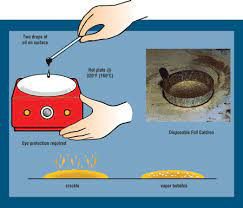
The crackle test was discussed briefly in OilChat #71 (Dipstick Oil Analysis). It is a quick and easy method to detect the presence of water in oil. To do a crackle test simply put a drop of oil on a hot surface with temperature just over 100°C. The oil will bubble, crackle or pop when moisture is present.
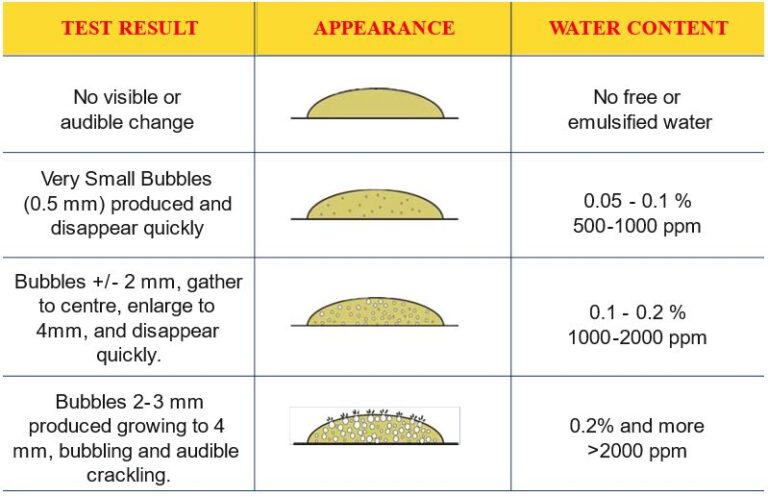
With practice, and together with keen eyes and ears, the crackle test can be a semi-quantitative estimate of the amount of moisture present in lubricating oil. Water is one of the biggest enemies of lubricants and the warning limit for moisture in petrol and diesel engine oil is 0.2 % maximum. A moisture content as little to 0.05% can be detected with the test. Rather than just listening for the crackle, add a visual observation and rating of the number and size of the vapor bubbles produced. This will give an indication of the amount of moisture present in the oil. This method is referred to as the visual crackle test.
Success in using this procedure depends on practice and maintaining a constant hotplate temperature around 160°C. Place a homogenous drop of oil on the hot plate. To ensure a homogenous suspension of water in the oil, agitate the oil sample violently or take a dipstick sample when the engine is still hot. Observe and interpret the test result as follows:
Although the test is reliable in most instances, it does have some limitations:
- Hot plate temperatures above 160°C induce rapid evaporation that may be undetectable.
- The method does not measure the presence of chemically dissolved water.
- The presence of fuel and volatile solvents in the oil could be mistaken for water – indication of light hydrocarbons is a sizzling sound rather than a crackle.
There you have it – dipstick oil analysis in a few simple steps. Checking your engine oil level should never be the same again. Analysing the oil in your vehicle is like sending your blood to the lab for tests and engine oil analysis can provide clues about the health of your engine – without any invasive surgery. The real benefit of oil analysis is that it acts as an early warning system, alerting you of potential problems before they become an engine failure.
Once you have mastered the crackle test and the other oil tests discussed in OilChat #71 and #72 you should be competent to determine the condition of your oil as well as the health of your engine. If you have any questions about these tests email us at info@bcl.co.za. Our lubricant experts will be happy to answer any questions you may have.
Want to learn more about our lubricant solutions?
CONTACT US